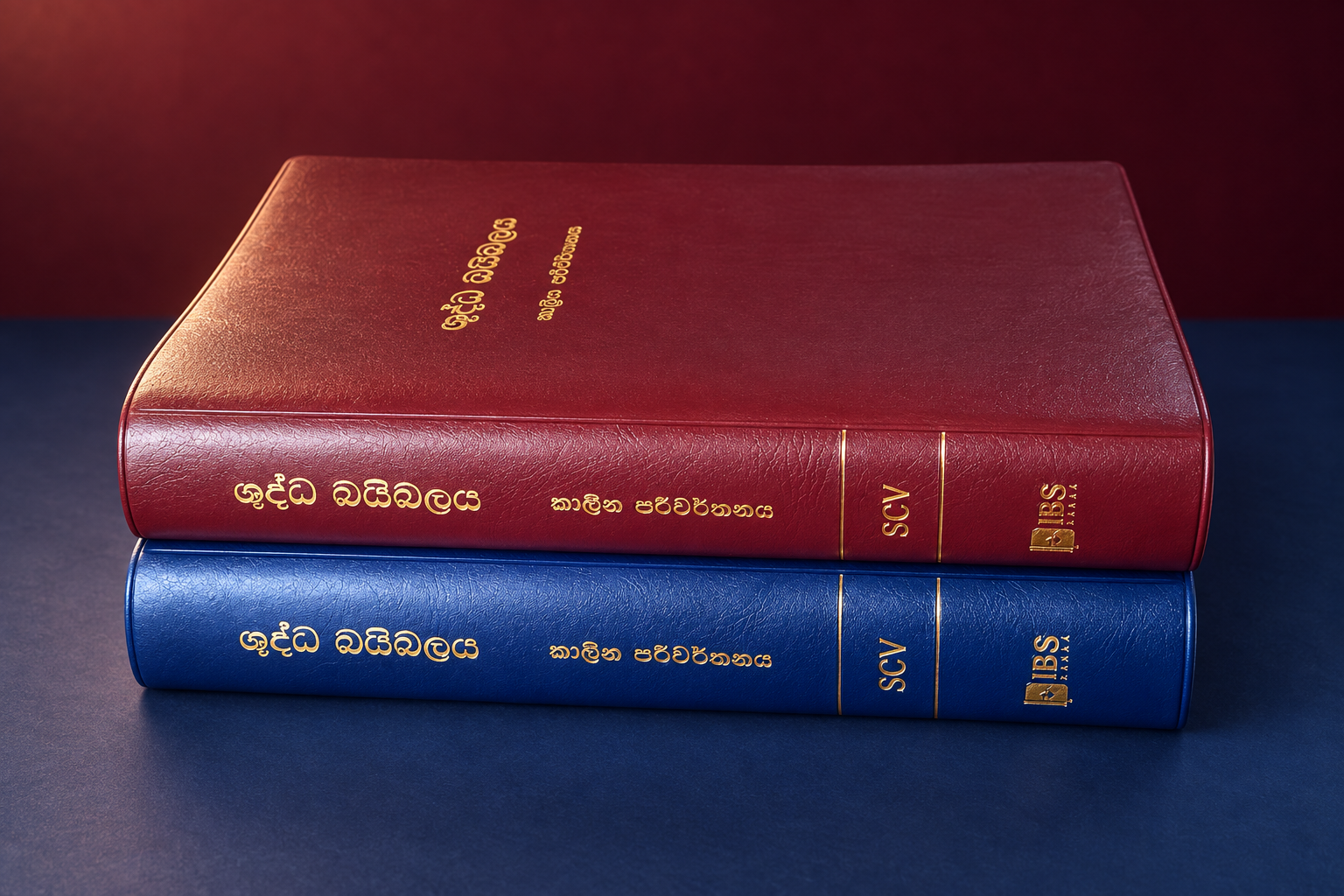
The Sinhala Contemporary Version grew through years of translation and sustained editorial checking. Its purpose is to convey the meaning of Scripture accurately in clear, natural Sinhala, so that readers can understand the biblical message and churches can teach it faithfully.
This account is adapted and expanded from observations by Rev. Simon Fuller, a linguist residing in Sri Lanka whom Biblica recognised as the project’s local Translation Consultant. It describes the principles and working practices he witnessed, together with the contributions of the wider editorial team.
Five principles guiding the work
Fuller identifies five related concerns: clarity, accuracy, naturalness, acceptability and consistency. These principles work together. A sentence can follow the shape of the source closely yet leave a Sinhala reader uncertain about its meaning. Equally, a smooth sentence can introduce an implication that the source does not support. Editorial review therefore considers both what a passage says and how a Sinhala reader is likely to understand it.
- Clarity
- The relationships within a passage should be intelligible: who is speaking, to whom a pronoun refers, how events follow one another, and how the clauses of an argument connect. Clarity does not remove the depth or difficulty of Scripture; it seeks to avoid difficulty introduced by the translation itself.
- Accuracy
- The translation should convey the meaning of the source as closely as possible. Individual words take their meaning from their context and their relationship to other words. Accuracy therefore requires attention to phrases, sentences and the surrounding passage, rather than a mechanical substitution of one word for another.
- Naturalness
- The text should read as good Sinhala. Differences in grammar, idiom and the organisation of information require thoughtful choices. The aim is for narrative to read as Sinhala narrative and poetry as Sinhala poetry while remaining faithful to the source.
- Acceptability
- The intended register is contemporary without being casual, idiomatic without being crude, and dignified without becoming inaccessible. Fuller also emphasises that translation should not become a means of advancing a particular doctrinal or sectarian agenda.
- Consistency
- The team gave sustained attention to important theological terms, personal and place names, parallel passages, spelling, punctuation and formatting. Readers should be able to recognise meaningful connections across Scripture.
Checking meaning in context
Checking a translation involves more than asking whether a Sinhala word appears in a dictionary beside a Greek or Hebrew word. It requires attention to semantics—the meaning a word or expression carries in context—and syntax, the grammatical relationships that show how a sentence works. A conjunction, a pronoun or a dependent clause can be crucial to understanding a biblical argument.
Fuller describes asking whether a nuance had been conveyed adequately, whether a word carried an unintended connotation, or whether a few words had been omitted. Such questions distinguish what the biblical author communicates from what a reader might inadvertently infer from the translation. The task is to preserve the force and relationships of the passage without adding an interpretation that its wording does not warrant.
Natural Sinhala and fidelity to the source were considered together. A change in sentence structure may help Sinhala readers follow the same sequence or argument that the original audience could follow. The test is whether the meaning is faithfully communicated, rather than whether the languages have matching word order.
The Old Testament textual policy
Fuller records an explicit policy for the Old Testament: the Masoretic Text was the principal textual basis. This is the received Hebrew textual tradition, including the Old Testament’s Aramaic portions. In the relatively few places where that text did not yield a clear meaning, the team considered interpretations found in other ancient versions.
The Septuagint, an ancient Greek translation of the Jewish Scriptures, is an important witness to the text and its interpretation. Consulting such a witness is distinct from routinely substituting its readings for those of the Masoretic Text. The SCV team’s stated policy was to translate the latter as it stood, while allowing consideration of ancient versions in genuinely unclear passages.
This policy also shaped the handling of apparent discrepancies in historical books. Where parallel accounts differed in names or numbers, the team did not automatically replace one reading with another to make the accounts agree. The aim was to let readers encounter the differences present in the chosen source text.
Theological terms and biblical names
Words such as righteousness, grace and law carry important theological connections. Consistency helps readers follow those connections between passages. At the same time, the contextual principle remains essential: consistency must preserve meaning, not impose a single Sinhala equivalent where the source expression functions differently.
Biblical names required hundreds of hours of attention. Familiar names already established in Sinhala usage were retained. Fuller notes that many familiar Old Testament names have been transmitted through their Greek New Testament forms; replacing them indiscriminately with forms based on Hebrew would make familiar people less readily recognisable.
For the many less familiar names found only in the Old Testament, the team sought more systematic renderings within the sound patterns available in Sinhala. Rev. Simon Fuller worked with the team on Hebrew names and a Hebrew–Sinhala reference list. This work helped the editors consider pronunciation and consistency together. Fuller also identifies the use of ෆ for the “f” sound in foreign names as a feature of the SCV.
Respecting parallel passages
Parallel passages are accounts with closely related wording, such as passages shared by Matthew, Mark and Luke, or by Chronicles and Samuel–Kings. They require comparison because a translator can accidentally introduce a difference where the source agrees, or erase a difference where the source varies.
The team sought matching renderings where the original wording matched and appropriate distinctions where it differed. This is particularly important when a reader compares accounts side by side. Consistency should make the relationship between the passages clearer without forcing them into a single harmonised account.
Fuller specifically notes that the team chose not to harmonise differing Old Testament names and statistics by appealing to the Greek text. That editorial restraint follows the stated textual policy rather than treating every apparent discrepancy as a translation error.
From a complete draft to a reviewed text
When Fuller joined the checking work around 2012, a draft of the entire Bible already existed. Brother Jerome had devoted many years to it, working with commentaries and keeping in touch with contemporary usage through daily newspapers. Fuller recalls discussing several chapters with him and finding both deep commitment to the work and receptiveness to suggestions.
Fuller’s responsibility as consultant was to check the Sinhala text of the entire Bible verse by verse alongside the original languages. Initially he recorded questions and suggestions as marginal notes. Hiran Edirisinghe sat with him in the early years, helping him explore how Sinhala expressions would be understood.
As the work developed, Fuller entered his questions directly into Paratext, where they were available to the rest of the team. His comments numbered in the thousands and covered clarity, vocabulary, ancient textual evidence, omissions, consistency, spelling, punctuation and formatting.
Examine the passage
Compare the Sinhala wording with the original-language text, considering its meaning, grammar and context.
Record a specific question
Identify a possible ambiguity, omission, unintended connotation or inconsistency, and propose clarification where appropriate.
Consider the proposal together
Bring the comment into the team’s review. A consultant’s suggestion was a contribution to that review, not an automatic alteration of Scripture.
Reach an editorial decision
Senior members considered the suggestions. Fuller records that some were accepted and others declined. Pastor Neville Jayasundara made the final decisions, consulting others where necessary.
Enter the authorised amendment
Sister Sriya entered the resulting changes under Neville’s direction. Fuller describes her as the person authorised to add to or remove from the project’s typeset text.
Complementary expertise and editorial responsibility
The process brought together different kinds of expertise. Fuller contributed decades of experience in Greek and linguistics, while working with the team on Hebrew and Greek checking. Sinhala-speaking editors could test proposed wording against the language’s grammar, usage and literary character. Their backgrounds in theology and the biblical languages also informed discussion.
Pastor Kithsiri Mudalige and Dr. Vinodh Gunasekera contributed semantic and theological analysis. Sister Sashila examined the quality of the Sinhala, including its grammar, spelling and flow. Dr. Ajith Fernando was consulted regularly as editing progressed. Pastor Neville Jayasundara served as a sounding board for difficult Sinhala questions and carried responsibility for final editorial decisions.
Sister Sriya’s role combined sustained knowledge of the text with responsibility for entering amendments in Paratext. Separating the making of suggestions from the authorisation and entry of changes helped keep the work coordinated. The account points to a human process of careful review and responsible judgement; software supported that work but did not replace it.
Paratext and the care of the finished text
Paratext provided a shared setting for reviewing the biblical text and recording comments. A specific wording question could be attached to the passage under consideration, making it available to the other reviewers. This supported an ongoing conversation about the text rather than leaving questions scattered across individual recollections.
Punctuation and formatting also required time. These details affect how clauses are read, where an argument appears to turn, and how a passage is followed aloud. Their review formed part of the effort to produce a coherent, readable Bible, alongside the more visible questions of vocabulary and interpretation.
Careful scholarship in the service of the Church
Fuller acknowledges that no human effort can be perfect. His eyewitness account nevertheless bears witness to decades of committed work, careful examination of the text, and a willingness to discuss and revise proposed wording.
The purpose of that care reaches beyond publication. A clearer sentence can help a child follow a biblical story, a pastor teach a difficult passage faithfully, or a reader recognise a call to repentance and hope. The SCV is offered in gratitude to God, with the prayer that those who hear His Word will encounter Christ and live in faithful response to Him.
Source: Rev. Simon Fuller, “The SCV: Some observations on the translation process.” Adapted and expanded for IBS Lanka, with editorial-team context from the SCV history. This page is an editorial account, not a verbatim statement by Rev. Fuller.
Read more about the people and partnerships behind the work in the history of the SCV.