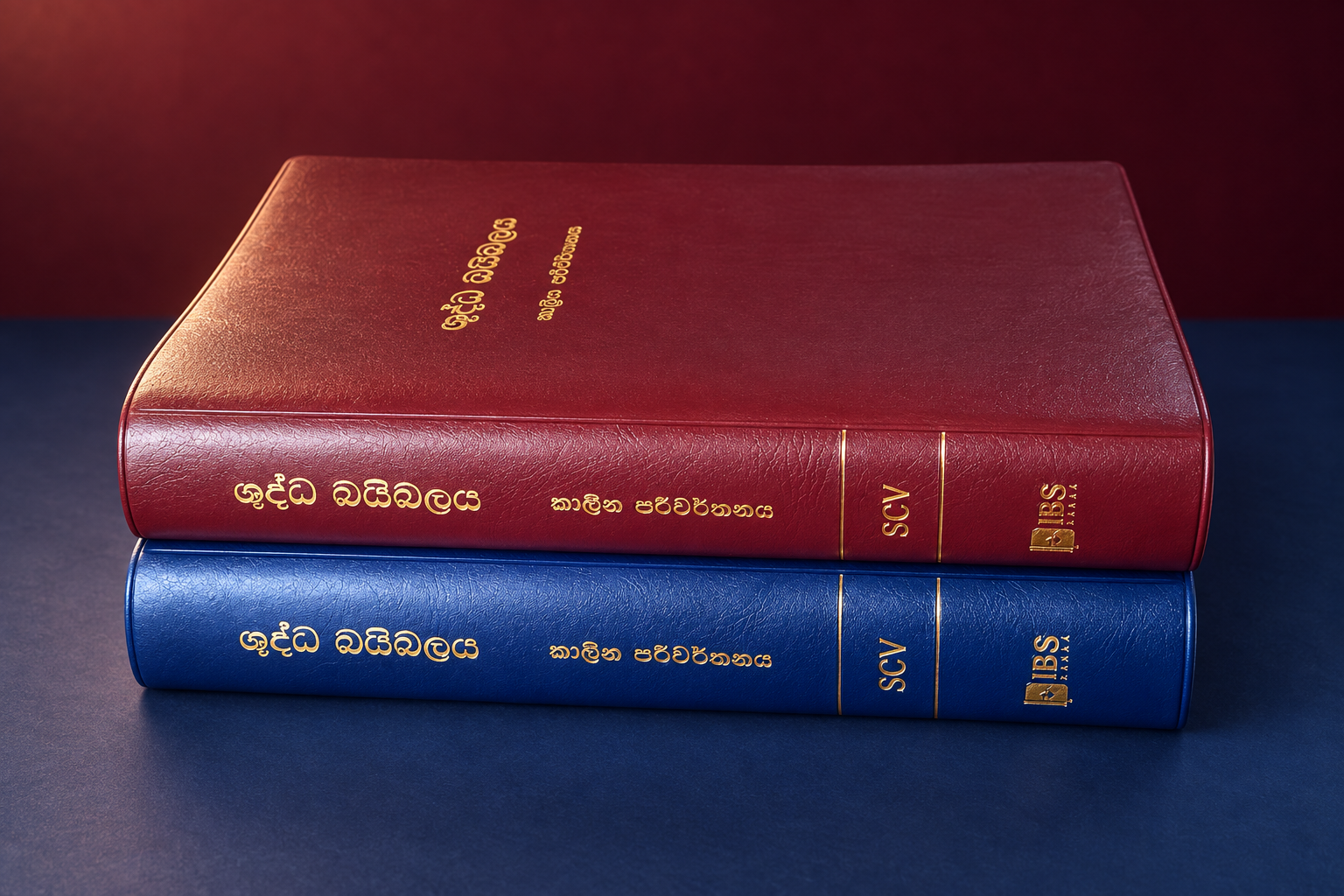
The Sinhala Contemporary Version of the Bible—SCV—is the fruit of more than forty years of translation, careful scholarship, prayer and perseverance. Its history brings together translators, pastors, language specialists, administrators, technical workers and generous supporters, united by a longing that Sinhala-speaking people might understand Scripture clearly, encounter Christ through its message, and faithfully live and teach God’s Word.
Sri Lanka already possesses a treasured heritage of Sinhala Bible translation. The SCV seeks to serve within that heritage, offering contemporary Sinhala readers a translation that combines clarity of expression with close attention to the meaning of the biblical text.
Its completion is also a testimony to God’s sustaining grace. Some who began the work did not live to see the finished Bible. Others carried it through years when progress was slow and resources uncertain. Their service is remembered with gratitude, while the thanksgiving belongs ultimately to the Lord who sustained them.
A vision patiently nurtured
The beginnings of the work reach back to the Bible translation initiatives of the 1980s. Brother Balakrishnan, the first National Director of IBS Lanka, helped establish the vision and invited Dr. Ajith Fernando to participate. Through his relationships with supporters and ministry partners, he also helped secure the resources that sustained the early work. The Tamil Readers Version was completed during his lifetime, forming another important part of the ministry’s service to Sri Lanka.
Brother Jerome Perera undertook the foundational Sinhala translation work. From 1991, Sister Sriya Edirisinghe worked alongside him as his secretary, typing the entire Bible in PageMaker. Brother Jerome did not work on a computer; the preparation of the electronic manuscript therefore depended on her patient, sustained labour. Their partnership at the desk was central to the development of the text on which later reviewers and editors would build. We remember Brother Jerome and Sister Kusum with deep gratitude as we honour his labour of love in translating the entire Bible. To undertake the translation of the whole of Scripture is a rare and remarkable accomplishment, requiring years of devotion, perseverance and sacrificial service.
Sister Sriya’s contribution continued through the final stages of the work. Despite limited formal computer training, she maintained continuity through successive rounds of typing, correction and review. Her remarkable memory of earlier decisions and of the progress of the manuscript became an invaluable resource to the team. Her quiet faithfulness helped hold the work together across the decades.
During these early years, much of the checking took place through printed manuscripts. Copies were circulated to a checking committee, and Dr. Ajith Fernando systematically worked through the text. This required sustained attention to the meaning of individual passages, their theological implications and the natural expression of those meanings in Sinhala.
The early work depended on a small team serving in different capacities. Early contributors and coordinators included Mrs. Gunawardene, Rev. Roy Rebeira of the Dutch Reformed Church and his wife, Mrs. Ramani Rebeira. Mr. Nelson Mendis assisted with the translation. Others who contributed included Mrs. Stella Dasan in administration, Mr. Barrington, and Mrs. Vinodini Christopher, who served as secretary to Brother Balakrishnan. Pastor Neville Jayasundara, Dr. Ragavan and Brother Kithsiri Rubasinghe, a Baptist pastor were among those who served on the checking committee. Their contributions formed part of the patient, often unseen work through which the Bible took shape.
Developing a translation for careful reading and study
In the early 2000s, the team gave renewed attention to the needs of Sinhala-speaking Bible students, teachers and pastors. Alongside accessibility, there was a growing desire for wording that would preserve more closely the connections, detail and structure of the biblical text.
The New International Version had been an important English reference during the earlier work. As the translation’s direction developed, the English Standard Version became an additional major reference, and Brother Jerome reviewed the translated text against it.
This did not make the SCV a Sinhala reproduction of the ESV, nor a translation of any single English Bible. English versions served as comparative resources within a wider process of translation and review that included attention to the biblical languages and consultation with specialists.
The editorial challenge was substantial. A translation intended for both ordinary reading and serious study must communicate naturally without obscuring important distinctions. It must attend to theological vocabulary, repeated expressions, the relationships between clauses, and the different demands of narrative, poetry, prophecy and apostolic teaching.
Throughout its development, the SCV sought to bring these concerns together: fidelity to the biblical message, clarity in contemporary Sinhala, and usefulness in the worship and teaching life of the Church.
Perseverance through difficult years
The International Bible Society, the publisher of the New International Version and the organisation later known as Biblica, provided the essential financial support that made the initial translation and review work possible. IBS Lanka remembers this foundational investment with deep gratitude. As the project developed, changes in priorities and translation approach led to a period in which regular financial support was no longer available.
During these difficult years, a small group continued the demanding tasks of editing, checking and coordination. Faithful donors helped sustain the work when resources were limited. Their generosity, together with the perseverance of the local team, enabled the translation to continue. Progress was often slow, but the conviction that the work should be completed remained.
Colombo Theological Seminary became an important source of support during the 2000s. Its principal, Dr. Ivor Poobalan, was an enthusiastic supporter and adviser. Many members of the CTS faculty also gave assistance when their expertise was needed.
This support was both scholarly and deeply practical. It helped sustain a work that required not only knowledge of language and theology, but also encouragement, continuity and patient Christian fellowship.
A renewed partnership with Biblica
A significant new phase began in 2018, when Biblica India renewed its engagement with IBS Lanka. Archived correspondence records preparations for a visit by Brother Aldrin Bogi and Brother Giju George, followed by a joint planning meeting on 4 July that year.
The partnership was formalised through an agreement effective 31 January 2019, involving Biblica, Biblica South Asia and IBS Lanka. It established a framework for completing the translation, supporting the work and providing for its publication.
The agreement recognised Biblica’s ownership of the intellectual property and envisaged publishing licences for IBS Lanka. It also provided for jointly appointed translation committees to exercise responsibility for the final wording of the text.
Biblica India’s contribution deserves particular recognition. Its colleagues helped coordinate the work, support the editorial process and move the project towards completion. Aldrin Bogi brought inspiration and encouragement; Giju George, Kunjumon Daniel, Joshy Abraham, and other colleagues contributed to the wider process of coordination, review and production.
Biblica’s involvement extended beyond funding. It included people, technical resources, translation support and the sustained attention needed to bring a complex project through its final stages. IBS Lanka gratefully acknowledges that, without Biblica’s partnership, the work would not have reached completion.
The editorial team and the care of the text
The later editorial work brought together complementary gifts in biblical interpretation, Sinhala language, pastoral ministry and technical review. Contributors included Dr. Ajith Fernando, Rev. Simon Fuller, Pastor Neville Jayasundara, Pastor Kithsiri Mudalige, Dr. Vinodh Gunasekera, Mrs. Sriya Edirisinghe, and Mrs. Shashila de Silva. Brother Neville Jayasundara devoted painstaking care to evaluating the Sinhala text. He was a trusted sounding board for many difficult questions of language, helping the team weigh alternative expressions and refine wording for clarity, grammatical accuracy and faithfulness to the intended meaning. His patient engagement with these questions was an invaluable contribution to the work. Dr. Ajith Fernando was consulted regularly as the text was edited. Dr. Vinodh Gunasekera and Pastor Kithsiri Mudalige provided semantic and theological analysis of the text. Sister Sriya Edirisinghe handled the entry of the text and editorial changes in Paratext during this stage of the work.
Rev. Simon Fuller worked closely with the translation team to check the Sinhala text against the Greek of the New Testament and the Hebrew of the Old Testament. Team members brought valuable insights to the Sinhala renderings from their varied backgrounds, their understanding of Sinhala and theology, and their own knowledge of Hebrew, Greek and Aramaic. Through this shared process of examination and discussion, they sought wording that faithfully conveyed the biblical meaning while remaining clear and natural to Sinhala readers.
Specialist advice was also sought from scholars including Professor G. P. V. Somaratna of CTS and Dr. Wickramasinghe of the Sinhala faculty of the University of Colombo.
The process involved multiple rounds of checking, with sustained attention to grammatical accuracy, spelling, terminology and the consistency of names. The team also carefully considered the rendering of the divine name and the treatment of headings associated with the Psalms.
These were not merely stylistic questions. Decisions about names, titles and recurring expressions affect how readers recognise connections across the Bible and understand the relationships between passages.
At certain stages, members of the team met almost daily to work through corrections. The finished text therefore represents far more than an initial translation: it embodies years of collective scrutiny, consultation and revision.
Hebrew names and consistency across Scripture
Rev. Simon Fuller also worked with the translation team on Hebrew names, preparing an extensive Hebrew–Sinhala names resource to support their discussions and decisions. This covered personal and geographical names as well as other significant terms. The team contributed its knowledge of Sinhala usage, biblical languages and theology in considering appropriate Sinhala renderings.
The surviving working tables compare the Hebrew forms, transliterations, proposed Sinhala renderings and forms used in existing Sinhala translations. They also include explanatory comments to guide decisions.
This work required balancing several considerations: the sounds of the Hebrew language, the capabilities and conventions of Sinhala writing, established usage familiar to readers, and consistency across different books.
Such detailed work is rarely noticed when a Bible is read fluently. Yet it helps readers follow the same people and places throughout Scripture and supports more confident teaching and study.
From manuscript to printed Bible
The project’s technical development accompanied its editorial development. Paratext supported the management and checking of the biblical text, while the later preparation of print layouts used PTXprint.
Translation and typesetting are distinct but closely connected responsibilities. A carefully checked manuscript must still be prepared for publication in a way that preserves the text accurately and presents it clearly. Book titles, chapter and verse numbers, headings, page layout and supporting material all require further attention.
Hiran Edirisinghe served for many years as the project’s administrator and coordinator. His loving, patient work in arranging meetings, maintaining communication and following through on decisions helped sustain the team and preserve continuity through successive stages of the translation.
Mr. Dinuk Senapathiratne undertook the formatting of both the New Testament and the full Bible. His work helped transform the edited text into the editions prepared for printing.
Mark Penny of New Zealand provided invaluable support by training Dinuk and Dr. Vinodh Gunasekera in PTXprint. This strengthened the team’s ability to manage the practical demands of Bible production.
Mrs. Sanjeewa de Silva has provided steadfast coordinating support since the 2020s, helping oversee the formatting and printing of both editions and organising much of the 2022 New Testament dedication and the 2026 full Bible dedication.
Mr. Nanda Lal Wijesinghe, who leads New Life Literature, provided tremendous assistance with printing both editions. His practical support and the work of the printing team helped bring decades of translation and editorial labour into the hands of readers. IBS Lanka remembers this partnership with deep gratitude.
The process continued after typesetting. Correspondence from Biblica documents further proofreading of the full Bible, including checks of book names, contents entries and consistency between the contents pages and the biblical books themselves. Completion required careful review of both the words and the pages on which they would appear.
The people who sustained the work
Alongside the translators and editors stood those whose administrative, pastoral and practical service kept the work moving.
Brother Austen Mascranghe carried substantial logistical and technical responsibilities. His contribution also extended to Tamil Scripture ministry: building on the earlier Tamil Readers Version completed during Brother Balakrishnan’s lifetime, he played a central role in its subsequent revision and production in Sri Lanka.
Dr. Samuel Anbahan Ariadurai was also instrumental in the latest revision of the Tamil Readers Version. His contribution reflects the commitment of IBS Lanka and its colleagues to serving both Sinhala-speaking and Tamil-speaking communities through Scripture.
Rev. Charles (Charlie) Jansz remained a faithful supporter of the work, offering encouragement and valuable insights through his participation in the life and deliberations of IBS Lanka. His continued interest and support were warmly appreciated by the team.
Their work reminds us that a translation is sustained by more than the people whose hands first shape its sentences. It also depends on those who faithfully organise, communicate, resolve practical difficulties and help others fulfil their calling.
Generosity that helped the work continue
Over more than forty years, many individuals, families, churches and ministry partners have sustained the work of IBS Lanka. The International Bible Society’s foundational funding, the support gathered through Brother Balakrishnan’s relationships, and gifts received at critical stages all belong to this shared history. No brief account can name everyone whose generosity helped the ministry continue, and those remembered here represent a much wider fellowship of faithful supporters.
Among those whose support for the SCV and the wider Bible ministry of IBS Lanka is gratefully remembered are Mrs. Saumya Lee, Mr. David Berberian, Mr. Jim Yarbrough, Mr. Nick Foley, Mrs. Patricia Vilvarajah and Dr. Lawrence Vilvarajah. Their generosity helped sustain translation and Bible distribution through demanding stages of the ministry. Mr. Nick Foley also contributed his legal expertise to the development of the agreement with Biblica.
Many others gave without public recognition. Their gifts, prayers and encouragement are no less part of this story. Together, these supporters helped place Scripture into the hands of people they might never meet, trusting God to bear fruit through His Word.
The New Testament milestone in 2022
The completion and dedication of the SCV New Testament on 2 December 2022 marked a deeply significant milestone.
For those who had carried the work through many years, it was an occasion of thanksgiving: the translated and reviewed text could now be placed in readers’ hands. It also opened a new chapter of ministry through reading, preaching, teaching and personal study.
Work on the Old Testament continued. Its breadth and variety demanded sustained attention—from historical narrative and law to wisdom literature, poetry and prophecy.
The New Testament dedication was therefore both a celebration of what God had enabled and an encouragement to persevere with the remaining work.
The full Bible in 2026
In 2026, the full Sinhala Contemporary Version Bible reached completion. Its dedication is scheduled for 21 November 2026 at Kollupitiya Methodist Church, Colombo.
The occasion gathers together the fruit of decades: the original vision, Brother Jerome’s translation, the work of successive checking committees, the contribution of biblical and Sinhala scholars, the partnership of Biblica, and the practical service and generosity of many others.
Some who sowed into this work are no longer with us. Their absence deepens our gratitude for what they entrusted to those who followed. Others have remained through long seasons of uncertainty and now have the joy of seeing the Bible placed in the hands of Sinhala readers.
The dedication is an act of thanksgiving and renewed responsibility. The completion of a translation leads to the continuing task of helping people read it, understand it, teach it faithfully and respond to its message.
The present stewardship of IBS Lanka
The present Board continues this responsibility through the service of Dr. Ajith Fernando, Pastor Neville Jayasundara, Mr. Austen Mascranghe, Rev. Charles Jansz, Pastor Kithsiri Mudalige, Dr. Samuel Anbahan Ariadurai, and Dr. Vinodh Gunasekera.
Together with the wider team and ministry partners, they seek to steward the SCV so that its availability leads to meaningful engagement with Scripture—in churches, homes, places of learning and the lives of individual readers.
Entrusted to this generation and those to come
The deepest purpose of this history lies beyond the production of a book.
In Nehemiah 8, the reading of Scripture was accompanied by explanation so that the people could understand. In 2 Timothy 3:14–17, Scripture is presented as making us wise for salvation through faith in Christ Jesus and equipping God’s people for every good work. These passages express the hope that has sustained this undertaking: that understanding God’s Word will lead to faith, obedience and transformed lives.
The SCV is offered with the prayer that children will grow familiar with Scripture, families will read it together, pastors will proclaim it faithfully, and teachers will help others discover its depth. Above all, may readers encounter the Lord Jesus Christ to whom the Scriptures bear witness.
Psalm 145:4 speaks of one generation declaring God’s works to another. That calling reaches through the history of this translation and into its future. Those who laboured have entrusted something precious to those who will read.
May the Word entrusted to us take root in our lives, shape our churches, and bear fruit in generations yet to come. To God alone be the glory.